General objective
To validate the use of Hidramag® as a cost-effective, safe, and efficient solution for the treatment of mercury-contaminated soils.
Specific objectives:
-
Environmental:
- Reduction of soil contamination
-
Reduction of water contamination
-
Reduction of mercury dispersion into the air
- Improvement of the quality of surrounding water bodies
- Ensuring the reuse of waste generated in the MAGNA industrial process
-
Social and economic:
-
Provide decision-makers and regulatory bodies with new scientific evidence and objectives for inclusion in future soil remediation protocols
-
Preservation of cultural heritage assets at the Cerco de Almadenejos
-
Improve the social perception of Cerco de Almadenejos and Abbadia San Salvatore
-
Promote tourism at both sites
-
Exploitation:
-
Development of a business plan to define the commercialization strategy for Hidramag®.
-
Replication:
-
Replicate the project results in two additional locations.
Kick-off Meeting
Held at the Mercury Technology Centre in Almadén, with the participation of representatives from all partner institutions:
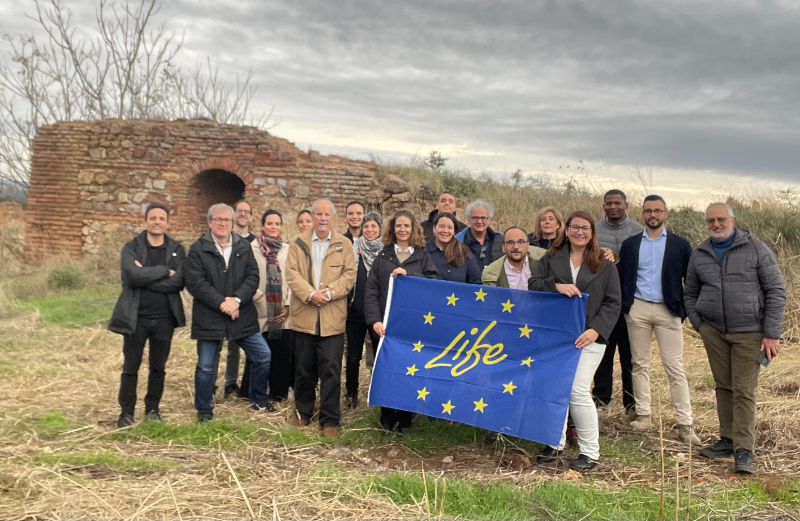 Group of HERMES project participants at the Mercury Technology Centre, Almadén.
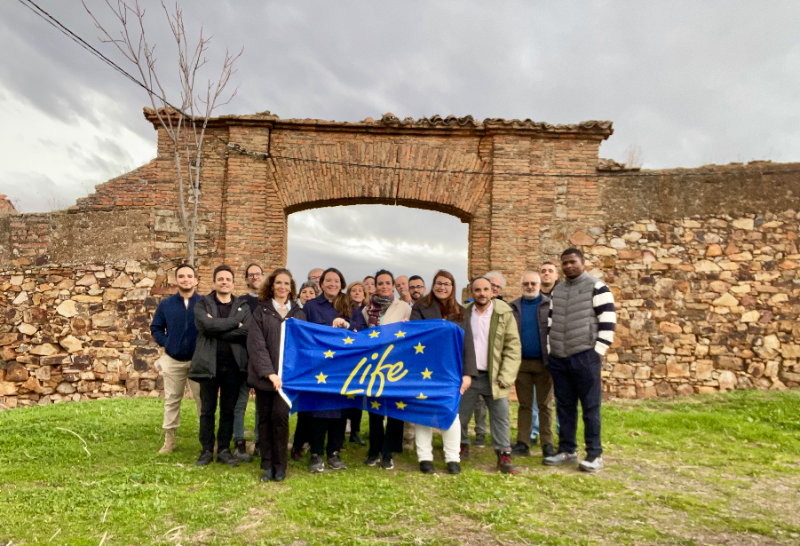 Visit to the Almadenejos Metallurgical Complex, where the decontamination activities will be carried out.
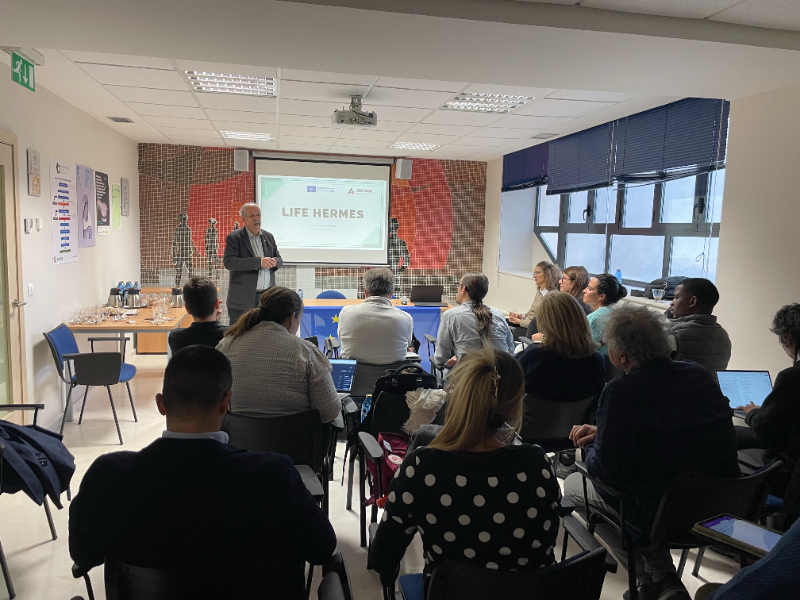 Intervention of Prof. Higueras (IGeA-UCLM) during the meeting.
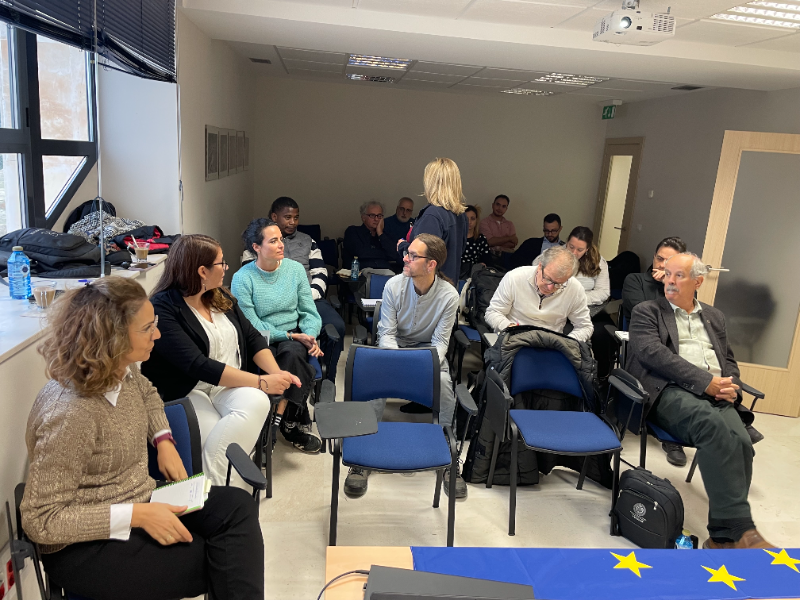 Working session and discussion of technical topics of common interest among the project partners.
Website Project LIFE-HERMES
Featured IGeA publication related to the HERMES project
The results of the HERMES project build on previous research carried out by IGeA-UCLM. One such study, recently published, validates the use of the red swamp crayfish as a key bioindicator for monitoring mercury contamination in mining-affected rivers:
Evaluation of the new role of the invasive species Procambarus clarkii as an environmental indicator in polluted watersheds
This work evaluates the potential role of Procambarus clarkii as a bioindicator of mining-related contamination processes. Unlike previous studies, which often focus on snapshot assessments of contamination levels, the approach adopted here integrates historical data and continuous monitoring programmes to provide a dynamic perspective on the impact of Hg and other metals on both biotic and abiotic media over an extended period. A total of 330 crayfish specimens were collected from 10 sampling stations in the Valdeazogues River, grouped by size classes, and analysed for Hg, Pb, Cd, Cu, Zn, As and Sb in abdominal muscle and hepatopancreas, together with a complete characterization of sediments and the aquatic environment.
The results obtained from the crayfish show that the hepatopancreas and muscle tissues present the highest average contents of Zn (1,325 and 377 mg kg⁻¹, respectively) and Cu (1,297 and 179 mg kg⁻¹, respectively). Hg levels were higher in muscle (1.6 mg kg⁻¹) than in the hepatopancreas (1.0 mg kg⁻¹), with all muscle samples exceeding the maximum permissible level established by the European Union for food consumption (0.5 mg kg⁻¹). The sensitivity of P. clarkii proved sufficient to identify different sources of Hg, Pb and Zn contamination within the drainage system, as well as agricultural sources of Cd downstream of the mining district. This versatility makes the species a potentially valuable tool for application in large mining areas of southern Iberian Peninsula, particularly throughout the Iberian Pyrite Belt.
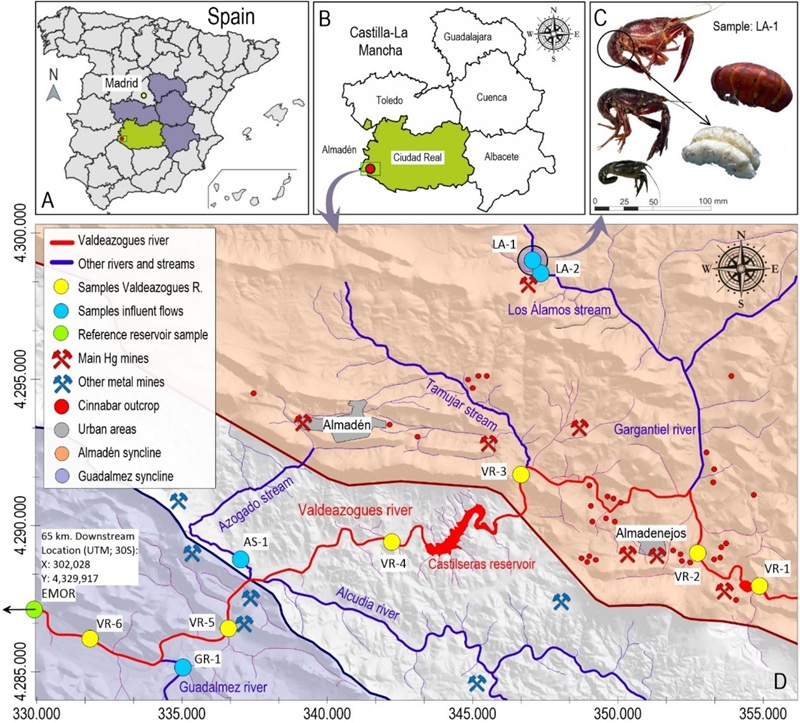 Location of the sampling areas (A and B); three size groups of specimens captured at LA1 and detail of the lyophilized abdominal muscle (AbM) (C); and location of capture sites, Hg mines and occurrences, as well as other relevant mines (D).
Source:
Evaluation of the new role of the invasive species (Procambarus clarkii) as an environmental indicator in polluted watersheds
Co-funded by the European Union. Views and opinions expressed are however those of the author(s) only and do not necessarily reflect those of the European Union or CINEA. Neither the European Union nor the granting authority can be held responsible for them.