Proyecto DiForMet – JCCM
| Título del proyecto |
Dinámica de la FORmación de
METilmercurio. Riesgos relacionados (DiForMet) |
| Referencia |
SBPLY_24_180225_000066 |
| Duración |
Fecha de inicio: 1 Septiembre 2025
Fecha final: 31 Agosto 2028
Duración: 36 meses
|
| Entidad financiadora |
Junta de Comunidades de Castilla-La Mancha |
| Beneficiario principal |
Instituto de Geología Aplicada (IGeA-UCLM)
|
Objetivo general
El Proyecto DiForMet, concedido al IGeA-UCLM, tiene como objetivo analizar en detalle el proceso de transformación del mercurio (Hg) metálico del suelo, como base para valorar de la forma más adecuada posible la disminución del riesgo que supone su presencia en suelos, aplicando técnicas encaminadas a la inmovilización del elemento.
Objetivos Parciales
-
Profundizar en el estudio experimental de las transformaciones del mercurio metálico en suelos
, mediante un completo diseño de experimentos que permita identificar los factores que influyen en la formación de posibles/probables precursores de metilmercurio y/u otras especies lábiles del elemento.
-
Contribuir al conocimiento de las aportaciones microbiológicas a los procesos de transformación del mercurio
: Análisis del impacto que dicho metal ejerce sobre las comunidades microbianas edáficas (previo a la adición de mercurio versus tras la adición de mercurio) en los siguientes aspectos:
-
La composición taxonómica y la diversidad génica de las comunidades microbianas.
-
La expresión génica.
-
el comportamiento funcional de la comunidad microbiana en respuesta a la alteración de la composición fisicoquímica edáfica.
-
El efecto sobre la respuesta de la comunidad microbiana frente a diferentes antimicrobianos de uso extendido en clínica humana.
-
Evaluar la respuesta de las comunidades microbianas frente a la presencia del mercurio
; así como su contribución a la generación o inmovilización de especies reactivas. Este análisis permitirá establecer una base sólida para diseñar estrategias de mitigación que reduzcan la movilidad y toxicidad del mercurio en el suelo.
-
Valoración de la posibilidad de aplicación de las técnicas desarrolladas a un área real afectada por contaminación significativa por mercurio
(Cerco Metalúrgico de Almadenejos, CMA).
Entidades participantes
-
Minas de Almadén y Arrayanes S.A.
: aporta su experiencia en estudios sobre el mercurio en el área de estudio.
-
Servicio de Apoyo a la investigación SAI-Microbiología de la Universidad San Pablo CEU
: aporta su experiencia en estudios microbiológicos aplicados a la caracterización de la salud del suelo.
-
Investigadores del Departamento de Geociencias de la Universidad de Florencia (Italia)
: aportan su experiencia en el estudio metodológico propuesto.
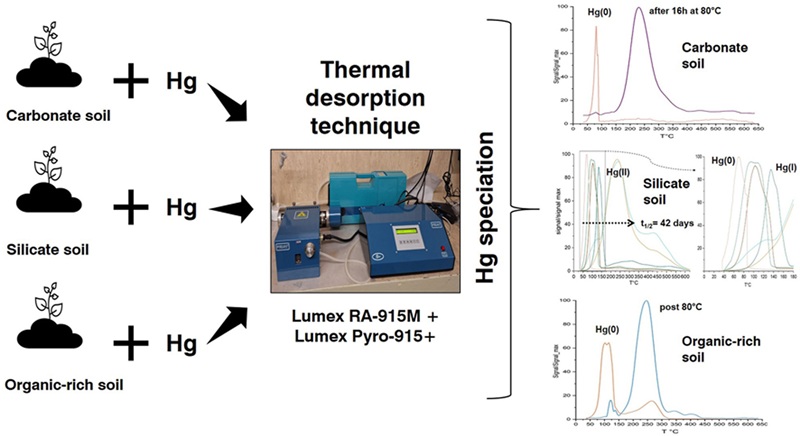 Técnica de desorción térmica para la especiación de Hg
. Esquema conceptual que muestra la interacción entre el mercurio (Hg) y tres tipos de suelo (carbonatado, silicatado y rico en materia orgánica), y su análisis mediante la técnica de desorción térmica. A la derecha, fotografía del sistema analítico utilizado: Lumex RA-915M + Lumex Pyro-915+, configurado para la determinación de Hg total y especiación termoquímica.
Técnica de desorción térmica para la especiación de Hg
. Esquema conceptual que muestra la interacción entre el mercurio (Hg) y tres tipos de suelo (carbonatado, silicatado y rico en materia orgánica), y su análisis mediante la técnica de desorción térmica. A la derecha, fotografía del sistema analítico utilizado: Lumex RA-915M + Lumex Pyro-915+, configurado para la determinación de Hg total y especiación termoquímica.
El Proyecto DiFoMet refuerza el liderazgo del IGeA-UCLM en la investigación sobre el ciclo biogeoquímico del mercurio y su gestión ambiental, complementando líneas de trabajo ya consolidadas en proyectos como LIFE HERMES y fortaleciendo la colaboración interdisciplinar e internacional en torno a la restauración de suelos contaminados.
Publicación destacada relacionada con el proyecto DiForMet
Técnica de desorción térmica para la especiación del mercurio en suelos carbonatados, siliciclásticos y ricos en materia orgánica
Fuente:
https://doi.org/10.1016/j.chemosphere.2024.143349
La desorción térmica es una técnica ampliamente contrastada para la especiación del mercurio (Hg) en suelos y sedimentos. Sin embargo, los efectos asociados a las diferentes matrices aún no han sido evaluados de forma adecuada. En este estudio se aplicó la desorción térmica a calcita libre de Hg mezclada con un patrón de Hg, así como a suelos ricos en minerales carbonatados y silicáticos y en materia orgánica. Se identificaron Hg⁰, HgCl₂, HgO, α-HgS, β-HgS y compuestos organomercuriales, poniendo de manifiesto que la matriz del suelo introduce diferencias notables en cuanto a las temperaturas de descomposición de los compuestos de Hg y sugiriendo que la composición mineralógica del suelo debe investigarse previamente a la aplicación de la técnica de desorción térmica.
Asimismo, se evaluó de forma detallada la presencia de Hg⁰, dado que, como ya se ha observado, este puede transformarse en Hg²⁺, lo que incrementa la movilidad del mercurio en la cubierta edáfica, con importantes consecuencias en suelos contaminados situados en las proximidades de minas activas o clausuradas y/o instalaciones industriales (por ejemplo, industrias cloro-álcali). Para ello, se realizaron ensayos experimentales utilizando suelos ricos en carbonatos, silicatos y materia orgánica dopados con Hg líquido. Se observó que el Hg⁰ tiende a oxidarse formando Hg⁺ y posteriormente Hg²⁺ en función de la matriz del suelo y del tiempo de reacción. De forma destacable, la velocidad de oxidación resultó ser relativamente rápida, ya que tras 42 días el contenido inicial de Hg⁰ se reduce a la mitad, siguiendo una cinética de decaimiento exponencial.
Esto implica que, en áreas contaminadas por Hg⁰, el destino del Hg²⁺ generado puede ser: i) su adsorción por la materia orgánica y/o por óxidos de Fe–Mn–Al, y/o ii) su incorporación a acuíferos someros. Este estudio supone un avance en la comprensión del comportamiento del Hg en suelos contaminados de origen industrial y minero donde el Hg líquido está presente en distintas matrices edáficas, y puede aportar indicaciones útiles para el diseño de operaciones de remediación.